Habit of Mind 6
Comparing within and among societies, including comparing societies' reactions to global processes.
Reflection
Lessons
that we learned from taking course included comparing and contrasting
societies impacted by local events. Before taking this class, the only
type of comparisons I did were those of venn diagrams, drawing two big
circles that overlapped each other. Mr. Rodriguez taught us that when
comparing two different societies, it’s important to see how a local
event affects the societies politically, socially, and economically. The
concept of comparing within and among societies and comparing the
societies’ reactions to global processes is very important to historians
and the students who take A.P. World History, because they need this
habit in order to help explain why something is happening in one society
but not the other. One of the key factors to remembering what happens
in history is by tying it together by global processes. Remembering the
Big Picture will help you especially when it comes to the A.P. test and
comparing societies in two different time periods. To improve this
skill, I had to develop a better understanding of what was going on from
the readings and focus on the commonalities and differences of the two
commonwealths. In class, Mr. Rodriguez would assign us charts dealing
with the different aspects of several societies, the beneficial of those
charts are that they organize what you can write about in an essay.
Sometimes Mr. Rodriguez would hint to us that the charts that he give us
for homework is the basis of the essay tests he assigns the next day.
Evidence
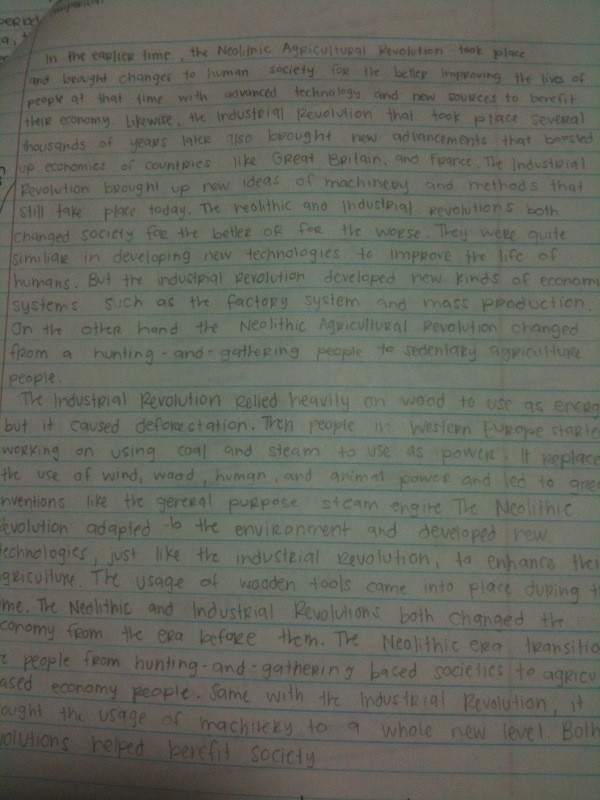
For habit of mind six, the evidence I chose is my comparison essay between the Neolithic Agricultural Revolution and the Industrial Revolution. In the essay I discuss how these two revolutions that occurred in two different time periods were similar in developing new technologies that improved life, but differed in how they affected society. The Neolithic Agricultural Revolution resulted in a new way of living just like the Industrial Revolution.